What You'll Learn:
Type a question into Google today, and you might not see a single blue link before you get an answer. Ask ChatGPT the same question, and it answers you directly - no clicking required. If you've noticed that how people search has started changing, you're not imagining it.
Don't worry. We're going to explain everything in plain English. No tech jargon, no confusing acronyms. By the end of this article, you'll understand exactly how SEO and AI search differ, and what both mean for your business - whether your customers are in Malaysia or on the other side of the world.
What is Traditional SEO?
SEO stands for "Search Engine Optimization." Think of it like running a shop on a busy street. You want a clear, readable sign, a listing in the right category of the local directory, and good word of mouth from happy customers. Do all three well, and more people find your shop without you having to chase them down.
On the internet, Google plays the role of that busy street. SEO is everything you do to help Google understand what your website offers and decide it's worth showing to someone searching for it. That includes:
- Keywords: using the words your customers actually type when searching
- Backlinks: other trustworthy websites linking to yours, like a reputation reference
- Content quality: genuinely useful pages that answer what people are looking for
- Technical basics: a site that loads fast, works on mobile, and is secure
Get this right, and Google rewards you with a good ranking. That's been the game for over two decades. But there's a new player at the table now...
What is "AI Search"?
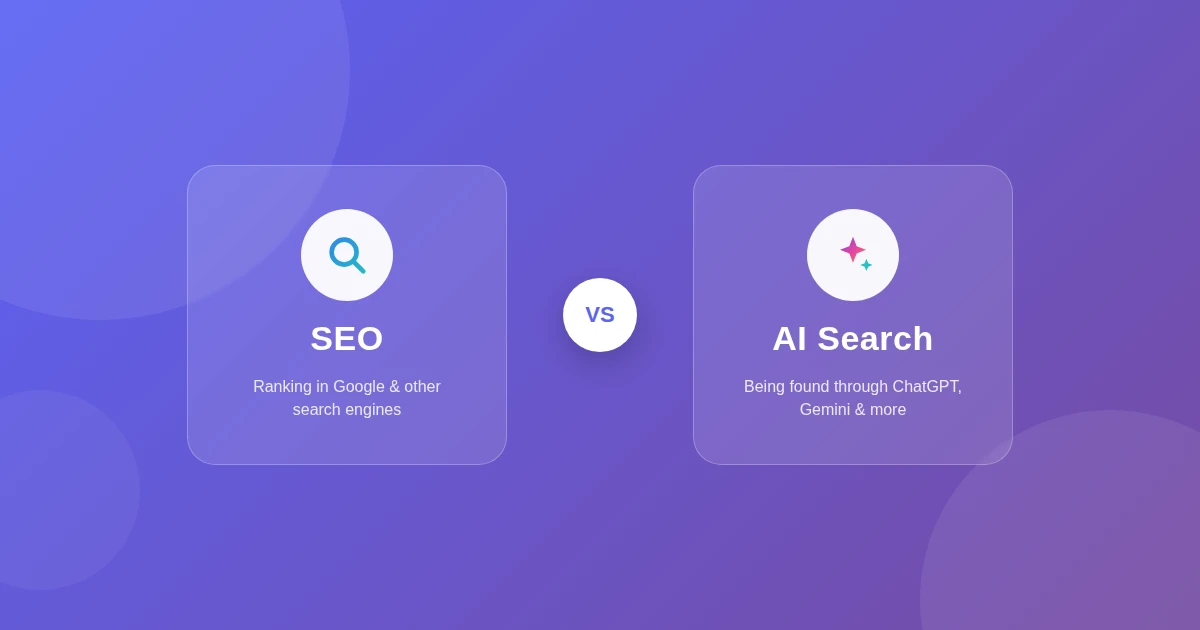
AI search works differently. Instead of showing you a list of links to click through, tools like Google's AI Overviews, ChatGPT, and Perplexity read across many websites, then hand you a single, direct answer - already summarized, already written in plain language.
Think of it like walking into a shop and being greeted by a knowledgeable assistant instead of browsing the shelves yourself. You describe what you need, and the assistant hands you the answer immediately, gathered from everywhere they've read - not just one shop's shelf.
This has a name in the industry: Answer Engine Optimization (AEO), sometimes called Generative Engine Optimization (GEO). Instead of optimizing to appear as a blue link, you're optimizing to be the source an AI trusts enough to quote.
The Catch With AI Search
Unlike a traditional Google result, an AI answer doesn't always send the person to your website at all. They might get their answer and never click through. This is often called a "zero-click" search, and it's becoming more common.
The Honest Comparison
Neither one replaces the other - they simply work differently. Here's how they compare side by side:
| Feature | Traditional SEO | AI Search |
|---|---|---|
| What You Get | A ranked list of links | A single, direct answer |
| How You're Found | Keywords and backlinks | Clear, well-structured, trustworthy content |
| Result for Your Website | A click to your page | Possibly cited, possibly no click at all |
| Best For | Detailed research, comparison shopping | Quick answers, direct questions |
| Content Style Rewarded | Long-form, keyword-rich pages | Clear headings, FAQs, direct answers |
| Where It Shows Up | Google and Bing search results | ChatGPT, Google AI Overviews, Perplexity |
Why This Matters for Your Business
Imagine a potential customer - whether they're in Petaling Jaya or on the other side of the world - typing a question into ChatGPT: "best web design agency for small businesses in Malaysia" or "affordable website services for startups." If your website doesn't have clear, well-organized content that directly answers common questions, the AI may never learn you exist, let alone recommend you.
This isn't hypothetical. More people every year start their research this way, especially for quick comparisons and local recommendations. If you've spent years building solid Google rankings but haven't thought about being "AI-search-ready," you could be losing visibility in a channel that's only growing.
Do You Need to Do Both?
Yes - and the good news is they overlap more than most people realize. The fundamentals that help you rank well on Google (fast loading, clear structure, genuinely useful content) are largely the same fundamentals that help an AI tool trust and cite your content.
- Structured data: hidden code that clearly labels what your page is about, helping both search engines and AI tools understand it faster
- Clear writing: content organized with real headings and direct answers, not buried in marketing fluff
- Genuine expertise: accurate, specific, well-maintained information beats vague generic claims every time
In other words, doing SEO properly today already puts you most of the way toward being AI-search-ready too.
How to Prepare
A few practical steps to make your website work for both traditional search and AI search:
- Write clear, direct answers to the real questions your customers ask (an FAQ section helps here)
- Use descriptive headings that summarize each section, not vague or clever ones
- Back up claims with specifics instead of generic marketing language
- Keep information accurate and up to date - outdated content is a red flag to AI tools too
- Add structured data (schema markup) so both search engines and AI tools can read your content correctly
- Show real authorship and publish dates - it signals trustworthiness to both readers and algorithms
Traditional SEO vs. AI-Search Readiness - Know the Difference
Traditional SEO and AI-search readiness are two different things. Traditional SEO covers the basics, like keywords and getting your site set up properly for Google. AI-search readiness is about writing clear, well-organized content that AI tools can easily understand and quote. Depending on your website package, we can help with one or both - just tell us what your business needs.
The Bottom Line
SEO isn't dying - it's expanding into a new format. The businesses that adapt to both channels, rather than betting everything on one, are the ones that stay visible no matter how someone chooses to search.
Whether your customers are searching from Malaysia or anywhere else in the world, the same principle holds: clear, honest, well-organized content wins - whether it's read by a person or an AI.
At AI360Fusion, we build websites with both traditional SEO and AI-search readiness in mind from the start, so you don't have to choose between them.
Quick Questions, Answered
Do I need to rebuild my whole website for AI search?
Usually not. Most sites just need clearer structure, headings, and content - not a full rebuild.
Is AI search going to replace Google?
Not any time soon. For now, the two work side by side, and being visible in both matters.
Does this cost extra if I work with AI360Fusion?
Traditional SEO and AI-search readiness are separate things, and what's included depends on your package. Message us and we'll tell you honestly what's included and what isn't.
Not Sure If Your Website Is Ready for AI Search?
Message us and we'll take an honest look at your current site together - no jargon, no pressure, just plain answers about where you stand and what (if anything) needs fixing.
Talk to Us on WhatsApp